


.svg)
.svg)
.svg)
The Evolution of Digital Identity in Modern Access Control
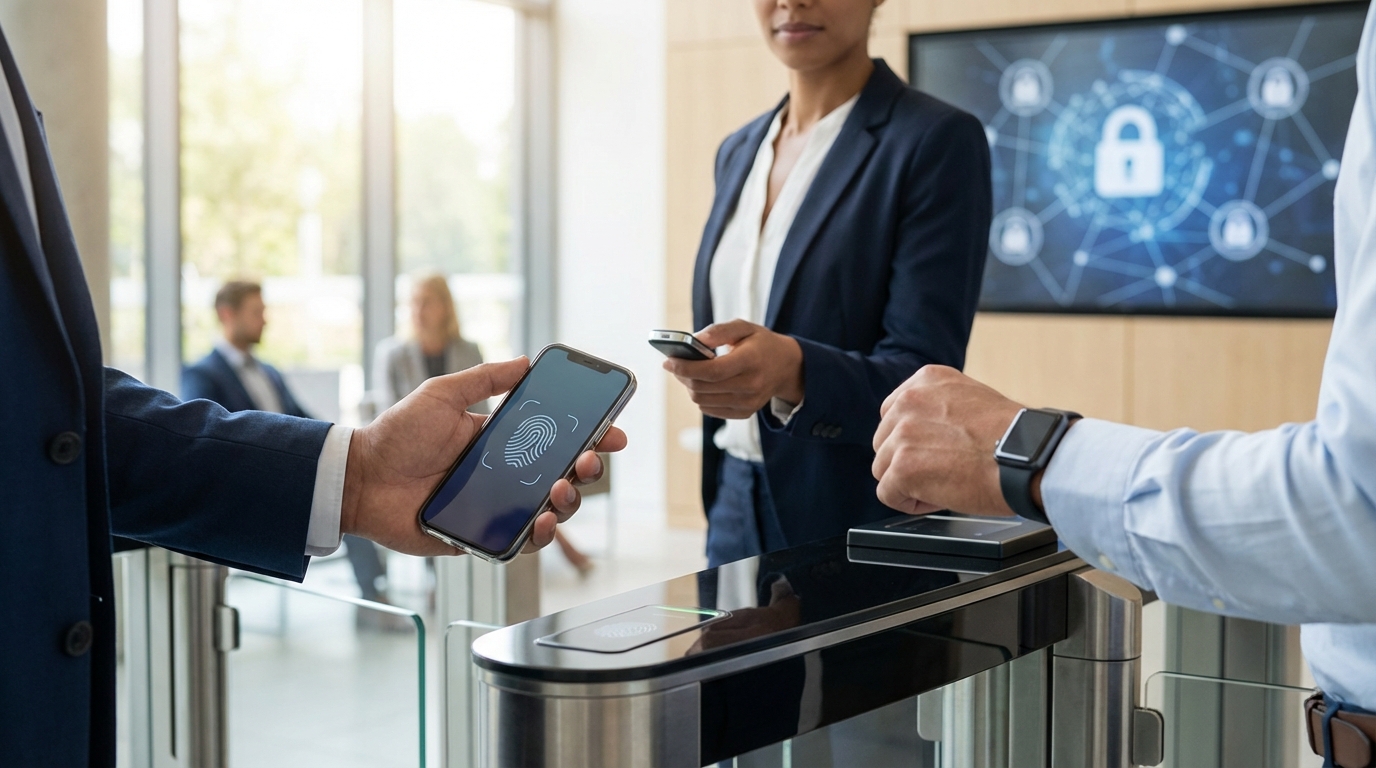
The plastic badge clipped to your lanyard is becoming a relic. Organizations managing thousands of employees across multiple facilities have discovered that physical credentials create more problems than they solve: lost cards costing $10-25 each to replace, security gaps when terminated employees retain access, and the administrative nightmare of managing badge lifecycles across departments. Digital identity solutions for access control have emerged as the answer, replacing fragmented legacy systems with unified platforms that authenticate users through their smartphones rather than easily duplicated plastic cards.
Corporate digital badge adoption currently sits at 45% and will exceed 85% by 2030 as hybrid work models normalize and security requirements tighten. This shift represents more than a technology upgrade. It fundamentally changes how organizations think about who gets access to what, when, and under what conditions. The old model assumed that possessing a physical token proved identity. The new model recognizes that identity verification must be continuous, contextual, and cryptographically secure.
What makes this transition particularly compelling is the convergence of several technologies: hardware-backed security through Secure Elements in modern smartphones, biometric authentication that users actually prefer to passwords, and cloud-based identity management that scales across global operations. Organizations deploying these systems report fraud rate decreases of 30-60% when transitioning from magnetic stripe to Secure Element credentials.
Shifting from Perimeter-Based to Identity-Centric Security
The traditional approach treated security like a castle: build strong walls, guard the gates, and assume everyone inside is trustworthy. This model collapsed when workforces became distributed and applications moved to the cloud. There is no perimeter to defend when employees access corporate resources from home networks, coffee shops, and airport lounges.
Identity-centric security flips this model. Instead of asking "are you inside the network?" it asks "who are you, and should you have access to this specific resource right now?" Every access request triggers an authentication event, regardless of the user's physical location. This approach treats identity as the new perimeter, with verification happening at every interaction rather than once at the building entrance.
The Role of Zero Trust Architecture in Identity Management
Zero trust operates on a simple principle: never trust, always verify. Applied to access control, this means continuous authentication rather than one-time badge swipes. A user's identity is verified not just when they enter the building but when they access the server room, log into sensitive applications, or attempt to download confidential files.
Modern identity platforms integrate with HR systems for automated lifecycle management. When someone joins the organization, their digital credentials are provisioned automatically based on their role. When they transfer departments, access rights update accordingly. When they leave, credentials are revoked instantly across all systems. This automation eliminates the dangerous gap between employment termination and access revocation that plagues manual processes.
Implementing Passwordless Authentication for Enterprise Security
Passwords are the weakest link in most security architectures. Users choose predictable passwords, reuse them across services, and fall for phishing attacks that harvest credentials. The average enterprise employee manages dozens of passwords, leading to either insecure practices or constant help desk calls for resets. Passwordless authentication eliminates this entire category of vulnerability.
The business case extends beyond security. Help desk calls for password resets consume significant IT resources. User friction during authentication reduces productivity and creates frustration. Passwordless systems using biometrics or hardware tokens provide both stronger security and better user experience, a rare combination in enterprise technology.
Eliminating Credential-Based Vulnerabilities
Credential stuffing attacks exploit the human tendency to reuse passwords. Attackers purchase stolen credentials from one breach and systematically try them across other services. Since 65% of users reuse passwords across multiple accounts, these attacks succeed far more often than they should.
Phishing attacks trick users into entering credentials on fake login pages. Even security-conscious employees fall for sophisticated phishing campaigns that perfectly mimic legitimate corporate portals. No amount of training completely eliminates this risk because the attack exploits fundamental human psychology rather than technical vulnerabilities.
Passwordless authentication renders both attack vectors obsolete. There are no credentials to stuff and no passwords to phish. Authentication happens through cryptographic challenges between the user's device and the authentication server, with private keys never leaving the hardware-protected Secure Element.
FIDO2 and WebAuthn Standards in the Workplace
FIDO2 and its web component, WebAuthn, provide the technical foundation for passwordless authentication. These open standards enable authentication through hardware security keys, platform authenticators built into devices, or biometric sensors. Major browsers and operating systems now support these standards natively.
The authentication flow works through public key cryptography. During registration, the user's device generates a key pair, storing the private key in the Secure Element and sending the public key to the server. During authentication, the server sends a challenge that only the private key can sign. The user authorizes this signature via a biometric scan or PIN, while the cryptographic operation occurs in tamper-resistant hardware.
Organizations implementing FIDO2 report dramatic reductions in account takeover incidents. The standards also support multiple authenticators per account, addressing the lost device scenario that concerns many IT administrators.
Biometric Access Control Systems Comparison
Biometric authentication has moved from science fiction to everyday reality. Your smartphone unlocks with your face or fingerprint. Airport security uses facial recognition to verify travelers. Corporate facilities authenticate employees through iris scans or palm prints. But not all biometric systems deliver equal security, accuracy, or user experience.
The choice of biometric modality depends on the deployment context. A high-security data center has different requirements than a corporate lobby. A manufacturing floor where workers wear gloves needs different solutions than an office environment. Understanding the tradeoffs between biometric approaches helps organizations select the right technology for their specific needs.
Physiological vs. Behavioral Biometrics
Physiological biometrics measure physical characteristics: fingerprints, facial geometry, iris patterns, and palm veins. These traits remain relatively stable over time and provide high accuracy in controlled environments. Fingerprint readers dominate the market due to their low cost and user familiarity, though facial recognition is gaining ground as camera quality improves.
Behavioral biometrics analyzes patterns in how users interact with devices: typing rhythm, mouse movements, gait patterns, and voice characteristics. These measurements happen continuously and passively, enabling authentication without explicit user action. A user's typing cadence can verify their identity throughout a session rather than just at login.
The most sophisticated systems combine multiple biometric factors. A smartphone might verify the user's face to unlock, then continuously monitor behavioral patterns to detect if the device changes hands. This layered approach provides strong security without creating authentication friction.
Evaluating Accuracy, Speed, and User Friction
Biometric systems are evaluated on several metrics. False acceptance rate measures how often the system incorrectly authenticates an imposter. False rejection rate measures how often legitimate users are incorrectly denied access. Equal error rate represents the point where these two rates are equal, providing a single number for comparing systems.
Speed matters in high-throughput environments. A turnstile at a stadium entrance needs sub-second authentication to avoid queues. A door reader at a secure facility can tolerate slightly longer verification times. Modern facial recognition systems achieve authentication in under 300 milliseconds, fast enough for seamless access without users breaking stride.
User friction encompasses the entire authentication experience. Systems requiring users to position themselves precisely, remove glasses, or make multiple attempts create frustration that drives workarounds. The best biometric systems feel invisible, authenticating users without conscious effort.
Decentralized Identity and Self-Sovereign Frameworks
Traditional identity systems place organizations in control of user credentials. Your employer issues your badge, your bank issues your card, your government issues your ID. Each organization maintains its own database of identity information, creating silos that don't communicate and single points of failure that attract attackers.
Decentralized identity inverts this model. Users hold their own credentials in digital wallets, presenting them to verifiers as needed without the issuing organization's involvement in each transaction. This approach mirrors how physical credentials work: your driver's license verifies your age at a bar without the DMV participating in that specific interaction.
Leveraging Blockchain for Verifiable Credentials
Blockchain technology enables decentralized identity through verifiable credentials. An issuing organization creates a cryptographically signed credential and gives it to the user. The user stores this credential in their digital wallet. When verification is needed, the user presents the credential, and the verifier checks its cryptographic validity against the issuer's public key recorded on a blockchain.
Government agencies are piloting digital driver's licenses and national IDs stored in Secure Elements. Age verification at retail locations, airport security checks, and online transactions can happen through zero-knowledge proofs that confirm eligibility without exposing birth dates or addresses. Current adoption sits at 20% but will grow to 70% by 2030 as regulatory frameworks mature.
The privacy implications are significant. Traditional verification requires sharing more information than necessary. Proving you're over 21 shouldn't require revealing your exact birthdate. Zero-knowledge proofs enable this selective disclosure, letting users prove specific claims about their identity without revealing underlying data.
Adaptive Authentication and Risk-Based Access
Static authentication treats all access requests identically. Whether you're logging in from your usual workstation during business hours or from an unfamiliar device in another country at 3 AM, the same credentials grant the same access. This approach fails to account for the dramatically different risk profiles of these scenarios.
Adaptive authentication adjusts security requirements based on contextual risk signals. Low-risk access requests proceed with minimal friction. High-risk requests trigger additional verification steps. This approach balances security with usability, reserving the strongest authentication for situations that warrant it.
Utilizing AI and Machine Learning for Threat Detection
Machine learning models analyze access patterns to establish behavioral baselines for each user. Deviations from these baselines raise risk scores and trigger additional authentication. A user who always accesses systems from the same location during the same hours creates a predictable pattern. When that pattern breaks, the system responds appropriately.
The signals feeding these models include device characteristics, network location, time of access, resource sensitivity, and behavioral biometrics. A login from a new device might be normal if the user recently received a hardware upgrade. The same login, combined with unusual access patterns and a high-value target resource, warrants scrutiny.
These systems improve over time as they accumulate more data about legitimate user behavior. False positive rates decrease as models become more accurate, reducing unnecessary friction for legitimate users while maintaining sensitivity to genuine threats.
Future-Proofing Your Digital Identity Infrastructure
The organizations seeing the greatest success with identity modernization share common characteristics. They treat identity as a foundational platform rather than a point solution. They integrate identity systems with HR platforms, access control databases, and application authentication. They plan for credential lifecycle management from the beginning rather than bolting it on later.
Implementation timelines vary based on organizational complexity. Baseline estimates suggest 6-9 months from pilot to full campus deployment, including reader hardware compatibility testing, access control system integration, and phased rollout across facilities. Organizations rushing deployment often encounter integration challenges that extend timelines and increase costs.
The technology landscape will continue evolving. Quantum computing threatens current cryptographic approaches, requiring migration to post-quantum algorithms. New biometric modalities will emerge. Regulatory requirements will shift. Building a flexible architecture that accommodates these changes protects your investment against obsolescence.
For organizations ready to modernize their access control infrastructure, working with experienced partners accelerates deployment and reduces risk. Paycloud Innovations specializes in secure, scalable solutions that integrate digital credentials with existing enterprise systems. Explore their approach to see how hardware-backed security and unified identity management can transform your access control strategy.




.svg)